Registration for the Boston Marathon opens today. As with last year, it is likely that all the slots will be taken and registration closed long before this year’s CIM takes place, effectively making the Boston qualifying time you expect to earn this December to be moot.
Some of the demand for marathon entries is clearly “industry-wide.” For example, our own CIM will sell out very soon. (The website says 325 slots remain as of today.)
The Wall Street Journal has an article on this excess demand for the Boston Marathon, which dares to ask the question of whether the qualifying times for women are too soft.
The Boston Athletic Association pegs the women’s qualifying times at 30-minutes slower than the men’s times, something they established in 1977. More that 30-years have passed. Do women still need this kind of advantage?
Although it sometimes feels good to take that long, slow stretch before a run, it turns out there’s not much science to support doing that kind of stretching.
NPR has another story on the evolving theories about how to stretch, whether to stretch, and the movement toward active isolated stretching.
I’ve long been a convert to the active isolated stretching camp, so I’m not surprised to be hearing more about it.
The story includes some videos on a couple of active stretches, but this video here will give you a better sense of how they work. The leotard is optional.
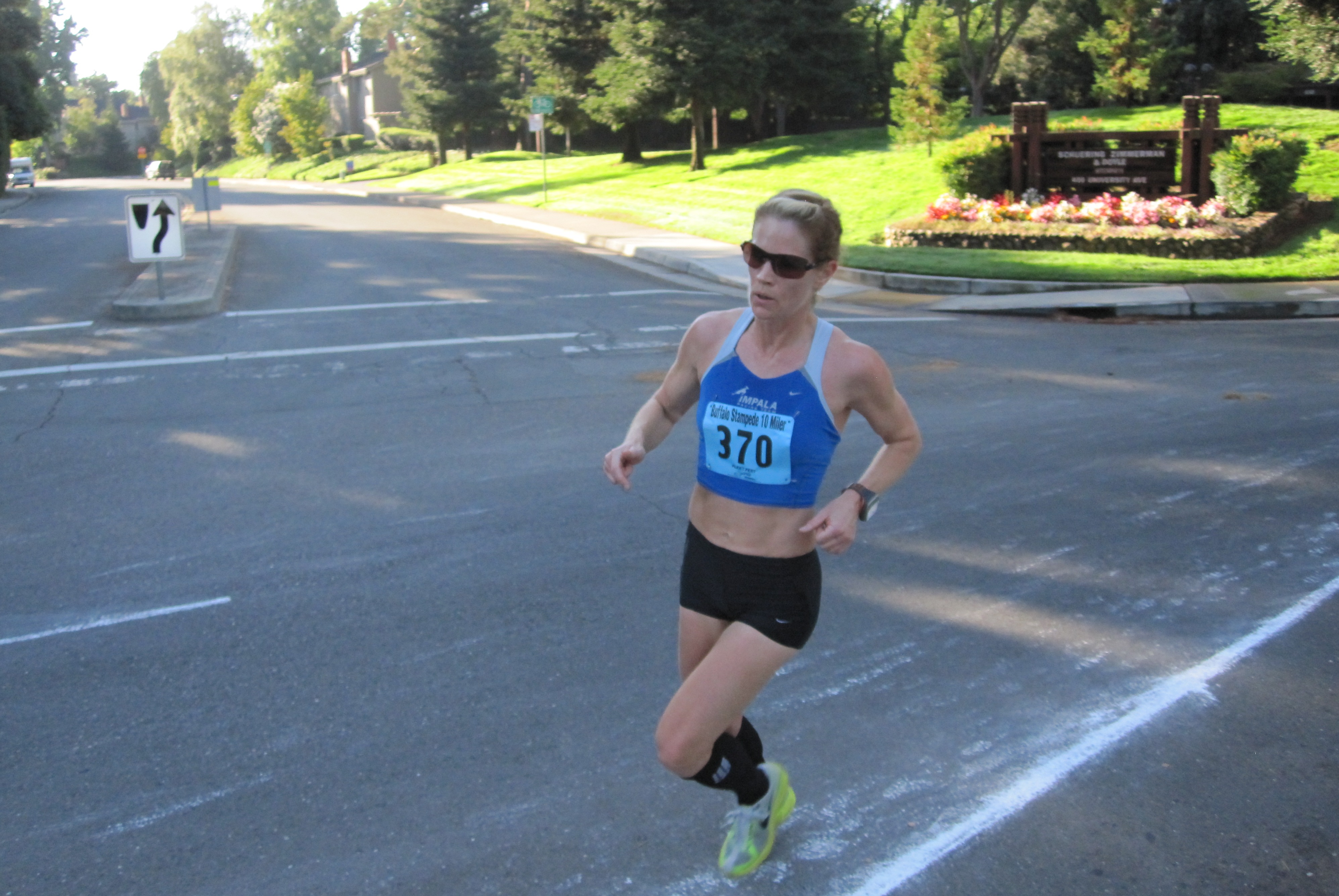
Jaymee Marty last month on her way to winning the Buffalo Stampede.
After years of very publicly training for it, and a couple near misses, Sacramento’s Jaymee Marty knocks out a Olympic Trials qualifier at the Chicago Marathon yesterday.
Under unusually warm conditions, Marty qualified with almost a minute to spare in 2:45:09, improving on her prior personal best of 2:46:26 from last year’s Twin Cities Marathon.
Marty is the third local woman to meet the Olympic B standard of sub-2:46. At 43, Marty also builds on a trend of local masters women superstars–Midori Sperandeo and Mary Coordt–who have already qualified for the 2012 trials. Will any “open women” runners (i.e., women under 40) qualify in this cycle? And what about the guys?
Jaymee Marty writes all about her race experience in her blog. Read it. It’ll bring tears to your eyes.
The County reports that the bathroom and drinking fountain along the American River Parkway at Sunrise is now complete and open for “business.”
The Monthly Ranger Report for August is also available here. (PDF) I must note this is the first time I’ve seen a bike vs. pedestrian accident.
There was also a report of a assault by a “jogger” on a bicyclist:
The male victim was riding his bicycle and encountered a jogger blocking the trail. The victim locked his brakes and was thrown from his bike. The suspect jogger struck the victim in the face with his fist. The suspect fled the scene.
I’m sure that’s exactly how it transpired. Come on people! There are rules and as I’ve said before they generally boil down to: share the road, pay attention, and don’t be a jerk. And don’t call runners “joggers.”
It was a glorious time for the sport, and for American running, as Joan Benoit ran away with a dominating win at the first women’s Olympic marathon. Her race that day in Los Angeles remains a thing of beauty and inspiration.
In case you don’t know, Joan Benoit Samuelson ran in the 2008 Olympic Marathon Trials as a 50-year-old and finished in 2:49:08. (Coincidentally, she finished a few seconds behind local runner Midori Sperandeo, which gave Midori a lot of t.v. time.)
This past Sunday, Paul Ngeny of Auburn (by way of Kenya) came to town and ran away with a commanding win of the now officially huge Urban Cow Half-Marathon.
Ngeny’s time of 1:07:51 was announced as a new course record, leaving this reporter confused as the race’s website lists Dennis Rinde’s 1982 course record as 1:05:38. (We promise to post an update when we figure this out.)
UPDATE: Race Director Rich Hanna explains that Dennis Rinde’s record is the “Race Record” set on the old Sacramento marathon course, but Ngeny’s time is the new course record for the Cowtown/Urban Cow course.
Following up in second and third were Chad Worthen of Sacramento and Ben Deland of Pleasanton, who finished in 1:13:17 and 1:14:35, respectively.
In the women’s race, masters runners dominated with Midori Sperandeo, of Folsom, picking up the win in 1:20:17, and Jenny Hitchings, of Sacramento, coming in second with 1:23:34.
October 03, 2010By: John Blue Category: Cross Country
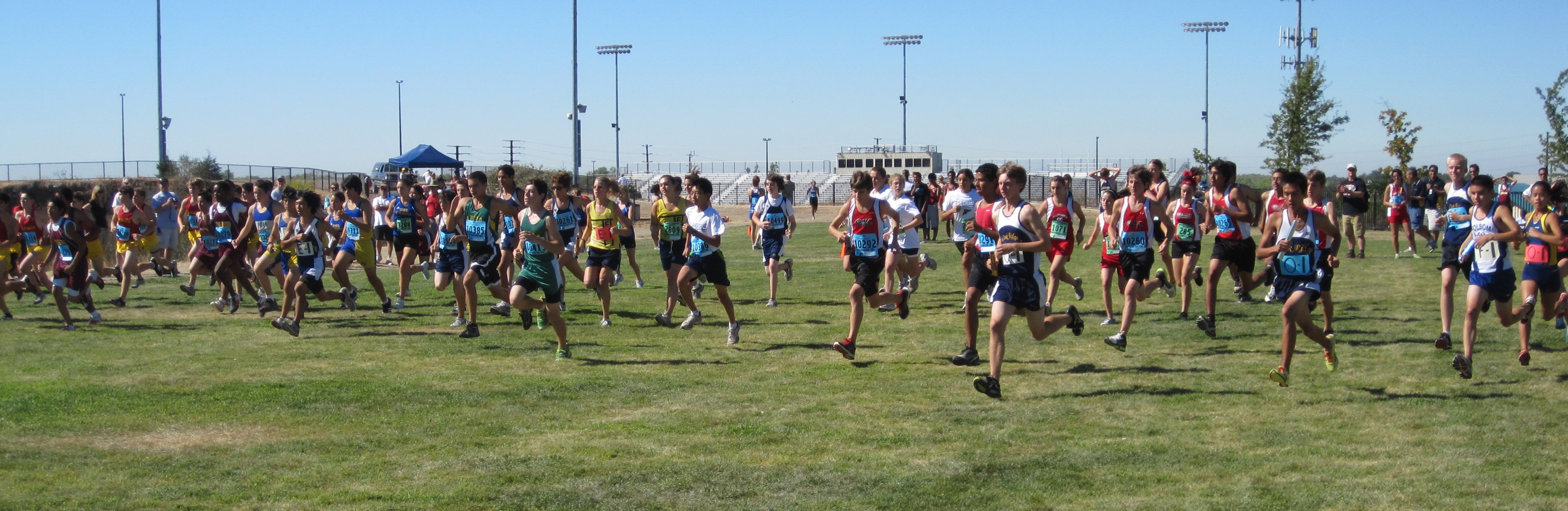
The start of the men's race at last year's Willow Hills XC race
If you have fond memories of the cross country races you ran back in high school, and are maybe getting a little tired of pounding out 5Km races on city streets, you might be happy to learn that the Sacramento area will be hosting two (Two!) adult cross country races this fall.
When I look at the calendar, I see that it is now autumn. When I go outside for a run, I still feel the iron grip of summer’s heat holding fast to Sacramento. But there are signs of change. The teams are back.
Nothing says “autumn is coming” like the herds of high school cross country teams hitting the bike trail. It harkens me back to a fictitious time in my youth, testing myself against my own preconceived limits. Learning that the pain was temporary but the accomplishment of a goal had permanence.
I’m embarrassed to say that the naked and less flattering truth is while I did go out for cross country in my sophomore year, I only made it through about a week’s worth of practices. I showed up the first week of school and got thrown into the pack that was running at what seemed like break-neck speed around the campus.
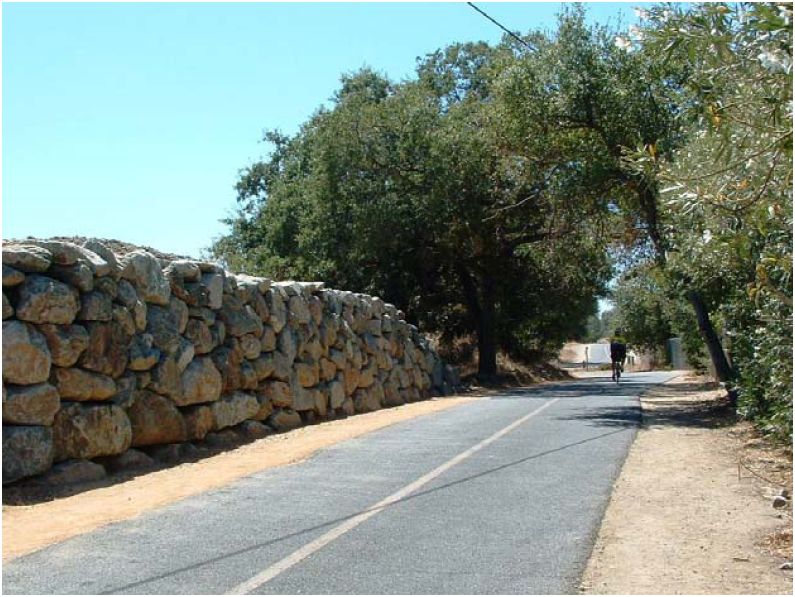
Last weekend, I ran downstream from Hazel Avenue and was treated to running on newly laid, decomposed granite shoulders tucked along visually breathtaking new retaining walls.